[Grace]
Paolo Sorrentino, 2025, 133m
2026/07/20
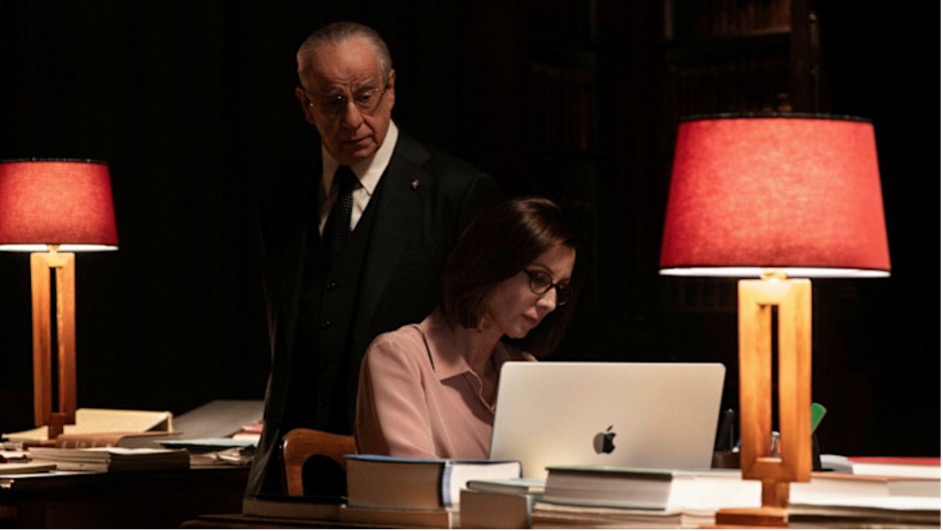
La Grazia opens with the story of a serious and responsible Italian president with six months left in office, and not so much left in his term of life also. It’s a time for reckoning. However, in contrast to director Paolo Sorrentino’s previous works about Italian presidents (Julio Andreotti and Silvio Berlusconi) this President is a fiction, though compellingly real in his presentation.
Much of the film takes place in sombre and dark state rooms with walls of legal books, many of them containing the 2,046 pages of Italian criminal law written by the main character, a former constitutional judge and now President of Italy, Mariano de Santis. Played with enormous skill by Toni Servillo, there is a greyness to the man, a trait he later acknowledges on the phone to Vogue’s editor. He runs his hand through his deceased wife Aurora’s colourful wardrobe and says she was the colour in the couple. The hue of her haunts Mariano throughout the film. In contrast, he learns his nickname is ‘reinforced concrete’.
The film’s themes are the big ones: life, love, purpose, death. Sorrentino takes us from the responsibilities of state, his last decisions revolve around a bill on euthanasia and pardons for two murderers. He confers with the Pope, there are visits to the murderers in prison, a terminally ill horse, the grandeur of the opera at La Scala. But humour is peppered throughout with a black dreadlocked motorbike riding pope, a horse called Elvis and a robot police dog. The single lunged president has sneaky cigarettes provided by his contuirissimo, and dinners of quinoa provided by his daughter, wonderfully played by Anna Ferzetti. But Mariano has served with diligence and honour, grace. It’s interesting that Sorrentino has created this character, a smart, learned, undeviating and responsible public servant. In today’s Maga-weakened world, it’s a character we almost can’t believe in any more. As Robert Abele put it in the LA Times:
“… when you consider current headlines, a thoughtful leader engaging with thorny issues from a place of psychological honesty, social integrity and fatherly love could almost count as fantasy.”
The soundtrack plays in to the entire narrative. The president’s son makes pop music in Canada, and the President laments that he no longer composes classical music, but the president listens to rap, he understands the needs to adapt and connect and ends up relishing rap on his new over ear cans. Sorrentino introduces an honours scene to allow Italian rap star Guè make a cameo appearance. The old and the new at every beat.
While the staff of state request permission before delivering opinion, Coco, the sharply humorous old friend needs no such diplomacy. She baldly states that he is heavy and she light, despite her earthly weight.
Mariano misses the love of his life, Aurora, but is haunted by an affair she had 40 years ago and obsesses over who the object of her affections was. When he tells his daughter, she laughs because it’s the first time she’s heard him say ‘fuck’, and dismisses his obsession with her lawyer’s summation that really it’s beyond the statute of limitations.
Staff respectfully request to put the horse out of his misery. The president denies the request. The presidents daughter attempts to get him to sign into law a bill on euthanasia, he delays, he prevaricates: “I need time to reflect”. Running out of patience, and life too, his loyal daughter demands “Who owns our days?”
Quite.
The President’s robes of office require the reception of dignitaries and there is a scene where Mariano receives the Portuguese president. The man despite sporting a most notable and noble moustache stiffly exits the car to walk the red carpet but the heavens descend and the wind whips up sending umbrellas inside out, the carpet flips up, the Portuguese president falls to his knees. Mariano looks on. It’s a slow motion-like scene played for discomfort, (will no-one help the man up ?) but the Portuguese man gets up and continues and the protocols of diplomacy, and of life, move our narrative forward. It’s what we do.
Mariano looks up to the night stars and to space where an Italian engineer lives without gravity. A live transmission is arranged on a big screen in the staterooms. The man appears anguished, and a tear escapes and floats towards the camera. And then the engineer laughs. It’s the human condition, if we’re not laughing, we’re crying. Both are necessary.
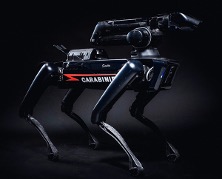
On his final day in office, the president decides to walk home, something he hasn’t done in seven years. The camera pulls back in front of him as he walks down the Via dei Condotti, past MaxMara, past Ferragamo. With his security detail behind him, leading the way to this new phase of his life is a carabinieri robot dog. The robot is from Boston Dynamics and goes by the name of Saetta in real life. This is a playful, if slightly odd, cameo and maybe it’s a nod to the biggest question of our times, which is who, or what, is leading us in to the future…