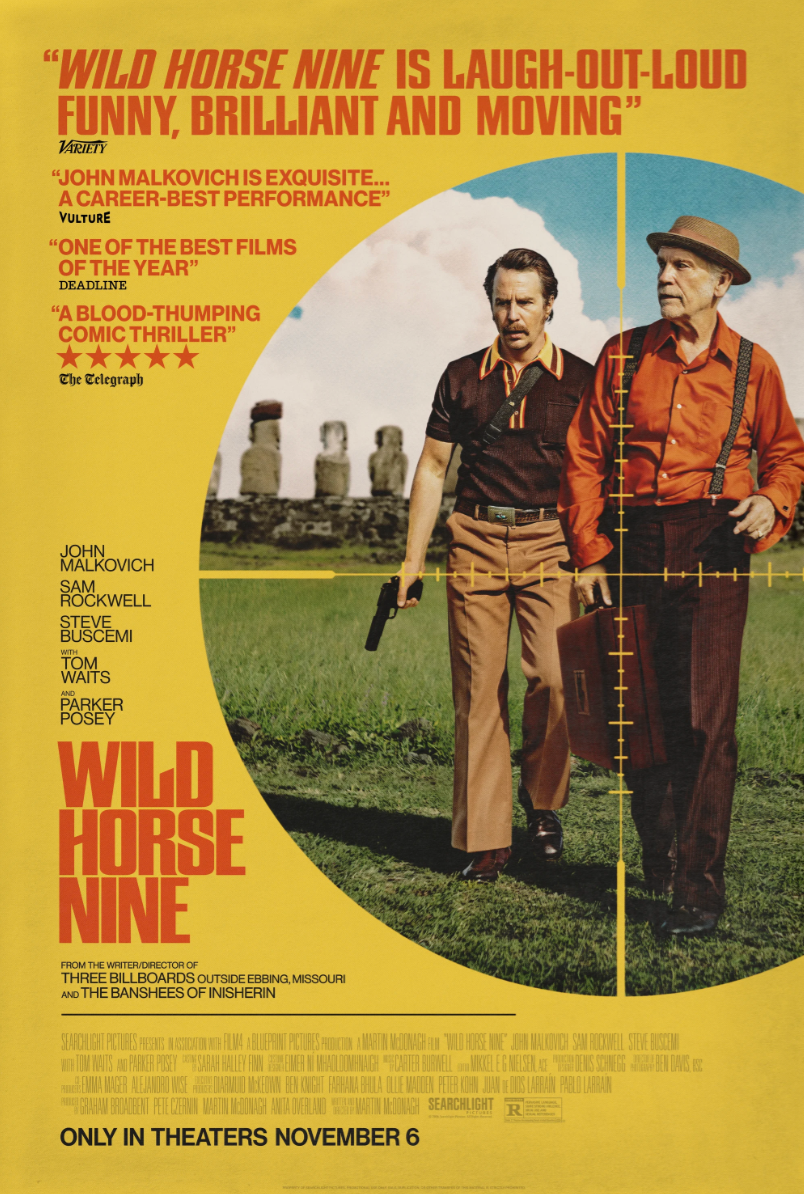
Martin McDonagh, 2026, 117m
2026/11/24
One of my favourite lines from Martin McDonagh’s latest film, and fifth feature, Wild Horse Nine relates to a CIA bro kill count one-upmanship, “I’ve killed people in countries you can’t even spell” states John Malkovich’s CIA veteran Chris. His colleague, Sam Rockwell’s wonderfully seventies cosplayed Lee responds “go on then, give me one”. “Czechoslovakia” says Chris. Lee is briefly stumped and then dismisses the claim: “you never killed anyone in Czechoslovakia, you just know I can’t spell it”. As we know, Czechoslovakia was subsequently split into the, easier to spell, constituent nation states Czech Republic and Slovakia, Czechoslovakia itself having previously emerged from territories of the collapsed Austro-Hungarian Empire. The film’s setting is drawn on political maps, and the action begins in 1973 in Santiago Chile amidst a CIA covert operation to topple its democratically elected president, Salvador Allende.
We learn that Chris has late-stage cancer and is now reflecting on his life, one spent carrying out CIA missions across the globe. Is it a life well spent? Now, he is not so sure. In contrast, his younger partner Lee goes along with the ‘end justifying the means’ dictum of US foreign policy. Today we might point to the US state funding of Israel, resources used by Israel to perpetrate genocide on the people of Gaza. A significant kill-count. (Curiously, when I was a young student in Ireland in the 70s, my school atlas labelled the political map of Israel as The Holy Land, reflecting a peculiarly Irish Catholic lens on the world.)
The action transfers to Easter Island (Rapa Nui) where ostensibly Chris wants to see the ‘heads’, the Moai, before he dies. He has also requested that Lee kill him there. Chris is taking morphine, his memory is impacted, and he writes notes to himself. One says “Don’t trust Lee!” Questions of truth and lies prevail, both providing for narrative suspense and reflecting the conflict endemic to the human condition. MJ, the CIA head in Santiago, played brilliantly by Steve Buscemi, is a morally bankrupt and decayed character both compromised and sustained by heroin. It’s a character Buscemi nails. McDonagh names the character with initials only, as if to signify the impersonal quality of the heads of the CIA. At the airport, Chris talks to two young female Chilean students, he talks too much, unequivocally telling them that Allende will be gone soon. They are confused and then shocked. Later, on Easter Island, he meets one of the young women again, Monica, and on hearing about his impending death she suggests he stops telling lies for his remaining time.
One of the greatest talents that McDonagh has is the ability to write dialogue that makes you laugh, out loud. At the same time, he can riff on the heavy themes of death and redemption, and state involvement in deposing democratically elected governments in places they have no business being. He points to the lengths the US state will go to in order to protect their interests, while simultaneously crowning themselves ‘leader of the Free World’.
The film revisits McDonagh’s earlier explorations of male friendship and expands on ideas of personal legacy with the reflections of this CIA operative’s life, a life perhaps not so well lived. Chris maintains he is a Catholic, but has not previously been too troubled by the ‘Thou shall not kill’ commandment. Is redemption possible?
Perhaps there is no time for atonement, but Chris does provide some advice to Monica and tells her to get away from Santiago. When that is not a realistic option, his parting shot is to kill anyone in military or police uniform and to never get in the car with them. Later, Monica remembers this advice when her trusted friend, now openly in military uniform, tells her to get in the car. Monica does not, and she survives. Her friend does not.
The kill count is high. But McDonagh brings the poignancy of death back to death in nature. Chris tells us that now he almost cares more for the moths of Chile than the people of Chile. The contradiction is stark. Wild horses roam freely on Easter Island, they are beautiful and inquisitive animals. One approaches Chris, he reaches out and strokes its head, and it connects him with nature. He later finds the horse dead by the road, killed by the machinations of people. This killing of an innocent and beautiful creature evokes a feeling of disquiet in us the audience. Just as Chris has become aware of the lives of moths, we the audience are triggered by the on-screen killing of animals. In The Banshees of Inisherin, Jenny the donkey also met an untimely end at the hand (or rather fingers) of man. In McDonagh’s first film, Six Shooter, it was a rabbit.
Lee wears a cowboy hat, exuding broad brimmed American charm and confidence, despite having been cuckolded by a clown. Chris’s topper is a pork pie, an appropriate nod to our uncertainty at times over whether he is in fact telling porkies.
In their portrayal of state-sponsored bad actors, both John Malkovich and Sam Rockwell re-affirm that they are phenomenal actual actors. There is also a great turn by Parker Posay playing Lee’s wife back in California. An aging, growly and hippy Tom Waits plays Chris’s estranged brother, another frequent member of McDonagh’s ensemble.
Martin McDonagh is the writer, director, producer, and chief bottle washer on this film – total creative control. He is, now, a proven auteur with the imagination and ability to fully realise his own vision, supported by regular collaborators. His deadpan humour is skilfully brought to bear on our human flaws and conflictions, whilst also leaving room for a poignancy that points to the possibilities for human redemption.
And if John Malkovich doesn’t get the Oscar, I’ll eat my hat.